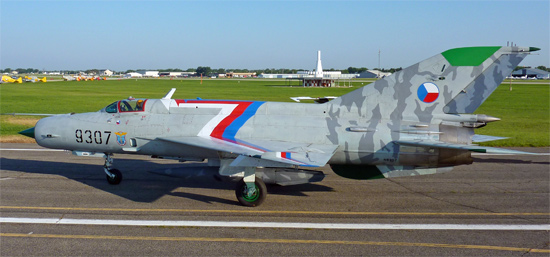
Will Ward's MiG-21MF, N9307, taxies in after arriving at
Oshkosh 2010.
Photo by Buck Wyndham
History:
Combat experience during the Korean
War demonstrated to the Soviet Union its need for a short-range air-superiority fighter.
The delta-wing MiG-21 met these requirements and through many variants and upgrades has
become the world's most used fighter aircraft. It is best remembered as the tenacious foe
of the F-4 Phantom during the Vietnam War.
During 1955, the MiG bureau designed the prototype
E-50 in an
effort to keep structural weight to a minimum for better performance. Multiple prototypes
followed before this small, daytime interceptor began flying with frontline Soviet units
in the late 1950s. Given the NATO reporting name "Fishbed," the
MiG-21
easily matched the performance of Lockheed's F-104 Starfighter. A
two-seat trainer version, the MiG-21UM, was dubbed the 'Mongol'
by NATO. The MiG-21PF was the second production version built,
and had all-weather interception capability. Later variants saw increased fuel capacity
and heavier armament, along with better avionics. At the same time, increasingly powerful
Soyuz engines were incorporated to compensate for the increasing weight.
Czechoslovakia, the Soviet Union, and China all manufactured
the MiG-21, and they were exported to various Soviet satellites during the Cold War. India
also produced the type under license until 1988. The Chinese F-7
variant is still in production.
The MiG-21 flies with more than 50 air forces today. Several MiG-21s of various versions
are owned and flown by private individuals in the United States, and at least one (a
MiG-21UM trainer) is owned by a private operator in Australia.
Nicknames:
Fishbed / Mongol (NATO
Codenames for MiG-21 and MiG-21 UTI trainer, respectively); Balalaika;
Blue
Bandit (US Codename in Vietnam); Vikram ("Valor") (Indian-built
MiG-21s).
Specifications (MiG-21MF):
Engine: One 14,550-pound thrust Turmanski R-13-300 turbojet with afterburner.
Weight: Max Takeoff 20,720 lbs.
Wing Span: 23ft. 5.5in.
Length: 51ft. 8.5in.
Height: 13ft. 5.5in.
Performance:
Maximum Speed:
1,385 mph (Mach 2.1) above 36,100 ft.
Ceiling: 50,000
ft.
Range: 685 miles
Armament:
One 23-mm GSh-23
twin barrel cannon in underbelly pack
Approx. 3,300
pounds of stores on underwing pylons
Number Built:
11,000+
Number Still Airworthy: Unknown number in
active military service; at least 8 airworthy in private ownership.
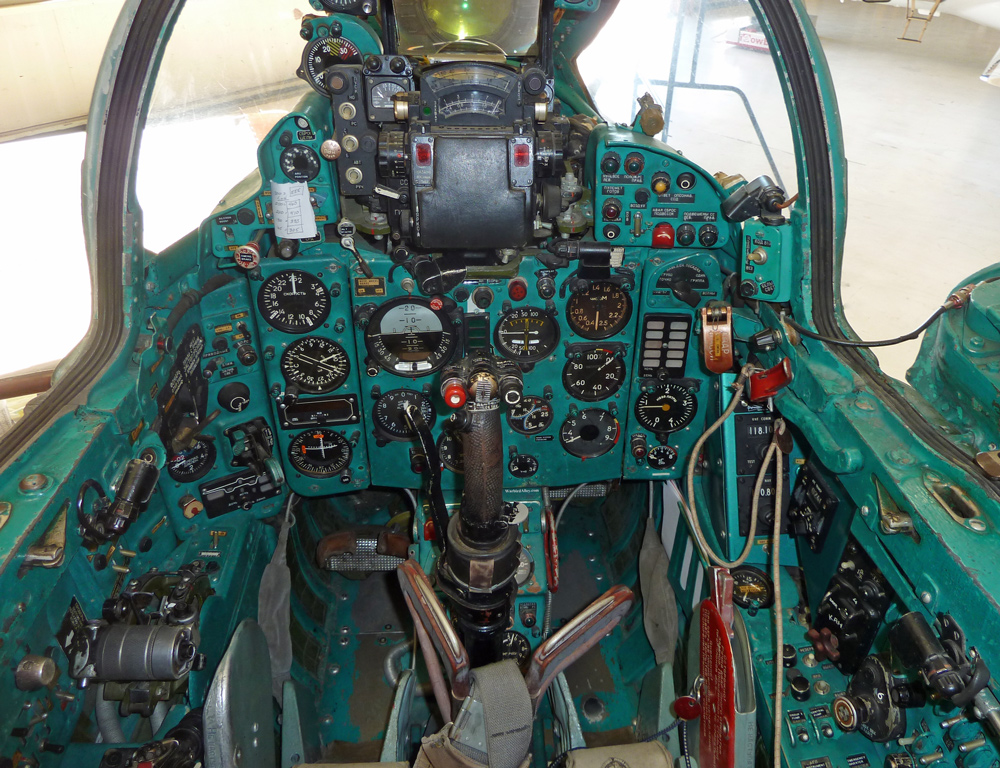
Cockpit Photo:
(Click for larger)
Links:
"Aero-Contact," Saxon, Germany and
Minden, NV, USA -- MiG-21 acquisition, sales, service and support.
All Red Star -- Information for operators
of Eastern-bloc aircraft.
Colorful Czech MiGs (photos)
Finnish Air Force Museum MiG-21
FlyMiG.com --
MiG-21 flight adventures in Moscow.
Indian Air
Force (IAF) MiG-21s in Combat
Lotnictwo OnLine MiG-21 Photo
Gallery
Matti Yrjola's Finnish Air
Force MiG-21 Page
MiG-21.de
-- Extensive archive of historical data and essays.
"Mogadishu
MiGs" Photo-essay -- Amazing photos of abandoned MiGs.
Photovault
Image Archive: MiG-21 Photos
Russian Military
Aviation Archive: MiG-21 Page
Thomas Kraft's
MiG-21 Page -- Lots of good information from a former East German MiG pilot.
USAF Museum MiG-21
Virtual Aviation Museum:
MiG-21 Page
Fly a MiG!